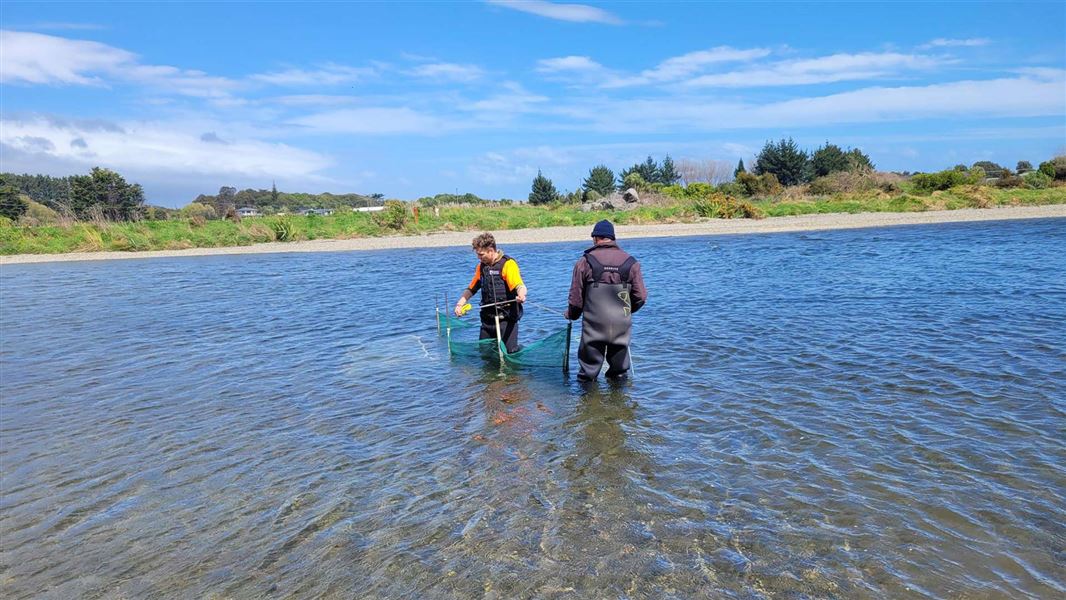
Whitebaiting season closed
Whitebaiting is only allowed during the whitebait fishing season. Taking whitebait at all other times is prohibited.
- New Zealand whitebaiting season - 1 September to 30 October (inclusive).
- Chatham Islands whitebaiting season - 1 December to the last day of February (inclusive).
Whitebaiting is allowed from 5 am to 8 pm or 6 am to 9 pm during daylight savings. In 2026, daylight savings starts 27 September 2026.
Remember to be Safe in the water and check up to date Check, Clean and Dry advice for whitebaiters to protect our waterways. Ensure you check with your local council or water authority for water quality information, especially after heavy rain.
This information is based on the Whitebait Fishing Regulations 2021. It is only a guide and does not contain all the rules.
What's on this page:
- Regulations
- Māori fishing rights and whitebaiting
- Where you can fish for whitebait
- Whitebait fishing gear
- Using your net
- West Coast of the South Island whitebaiting
- Report illegal activity
Regulations
Ensure you’re familiar with the Whitebait Fishing Regulations 2021 at legislation.govt.nz. Note that whitebaiting regulations differ in West Coast of the South Island to the rest of New Zealand.
Or watch our Regulations for whitebaiting short video.
Penalties for not complying with the regulations may result in:
- a $400 infringement fee, or
- prosecution with a maximum penalty of $5000, and
- seizure of your fishing gear.
Māori fishing rights and whitebaiting
The Whitebait Fishing Regulations 2021 don’t apply and have never applied to Māori fishing rights exercised by tangata whenua.
Visit Māori fishing rights and whitebaiting for more information.
Brochures
Print out a whitebait fishing regulations information leaflet in te reo or English.
- Whitebaiter's guide to whitebaiting brochure - English (PDF, 1,359K)
- Whitebaiter's guide to whitebaiting brochure - Te reo (PDF, 1,433K)
- Additional whitebaiting regulations for West Coast of the South Island – English and Te reo (PDF, 448K)
Where you can fish for whitebait
- Whitebaiting is only allowed in tidal waters.
- On some rivers, the extent of the tidal waters is marked with a back peg. Fishing for whitebait upriver of these back pegs is illegal.
- Fishing for whitebait is not allowed in any national parks or public reserves (under the Reserves Act 1977) anywhere in New Zealand.
- Fishing for whitebait is not allowed in a whitebait refuge. There are three regions with whitebait refuges:
Whitebait fishing gear
Fishing gear includes anything that is used for the purpose of whitebait fishing, such as nets, screens, stakes, ropes, and spotter boards. Fishing gear doesn’t include licenced structures, also known as stands.
All fishing gear must be:
- actively monitored so that you can immediately remove and release any species that are not whitebait
- removed from the water every time you move more than 10 m away from the net, even if it’s only to take a break or talk to someone for a short time
- removed from the water when you finish fishing or at the end of the day, whichever comes first
- no more than 6 m in total length, even if used from a licenced structure/stand.
Whitebait nets must not:
- be more than 3.5 m in length.
- have a mouth larger than 4.5 m when measured around the inside of the net frame
- have framing material wider than 120 mm.
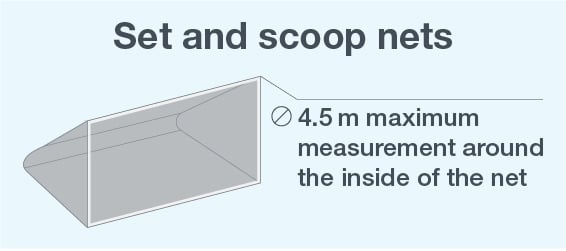
Image: DOC
A ‘drag net’ is any net or any rope, material or device used with the net that is weighted on the bottom edge. A drag net is drawn through the water and surrounds the whitebait.
All drag net type nets:
- must be flat when laid on a flat surface
- must not be more than 1 m in height
- must not be more than 3.5 m in length, and
- must not be used on the West Coast.
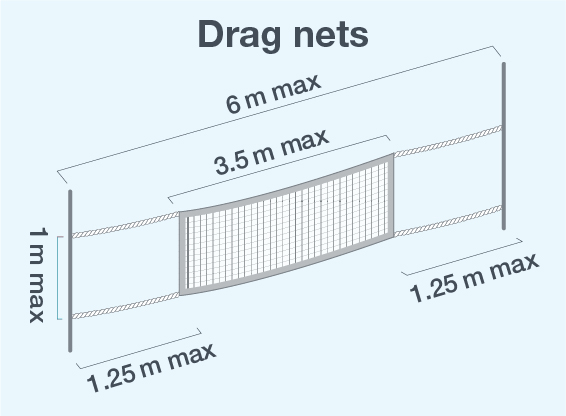
Image: DOC
Screens are the only device allowed to divert whitebait into a net. Screens must not be more than 3 m in length, unless used from a licensed structure (stand).
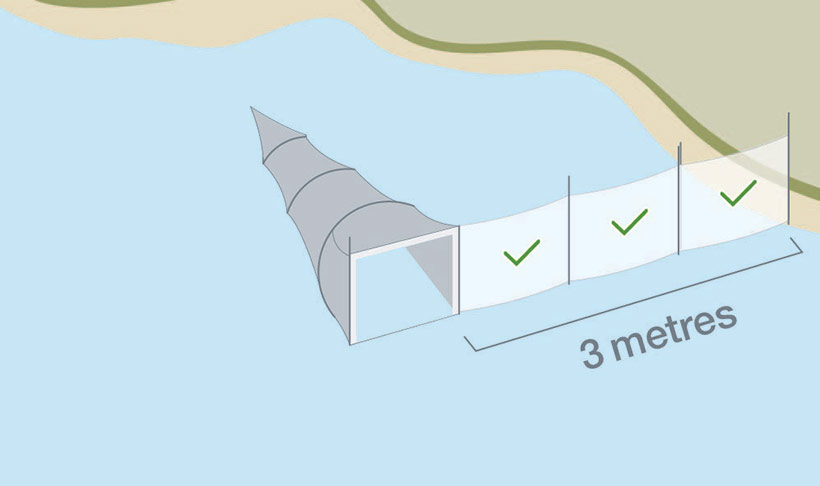
Image: DOC
Using your net
When setting up your gear, any configuration of nets and screens is allowed, except on the West Coast of the South Island. For example, outside the West Coast of the South Island, you could use a 2 m screen, then your net, then a 1 m screen on the outside of your net. See Additional rules - West Coast of the South Island for the different rules that apply on the South Island of the West Coast.
Fixed fishing gear is any fishing gear that is fixed to the riverbed by stakes, pegs or ropes.
You must maintain at least 20 m between fixed fishing gear, except when fishing from a licenced structure. There is no minimum distance between scoop or drag nets.
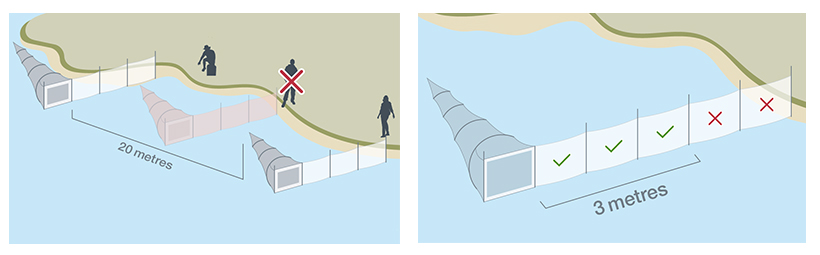
Image: DOC
When whitebait fishing, you must not:
- use more than one net at a time
- use fishing gear that exceeds 6 m in length
- use more than 3 m of screens, except from a licenced structure
- fish from a bridge or boat/vessel
- use gear that takes up more than one quarter of the width of the waterway, either separately or combined with someone else’s gear
- create any diversion or alter or modify the natural bed or banks of any river, stream, estuary or channel
Net placement
Placing nets near some structures or natural features which may cause whitebait to congregate is not allowed.
You must not place you net within 20 m of the following:
- Weir – A barrier built across a river or stream to control water flow. It often looks like a low dam.
- Culvert – A pipe or tunnel that lets water flow under a road, track, or embankment.
- Groyne – A structure made of rock or other material that extends into the water to alter flow and reduce erosion.
- Outfall structure – A conduit or pipe that discharges water into a waterway.
- Confluence – The place where two streams or rivers meet.
- Tidegate or floodgate – A gate that can be opened or closed to control water flow.
- Unlawful diversion – Anything constructed on the bank or in the bed of a river, stream, estuary, or channel which may divert whitebait.
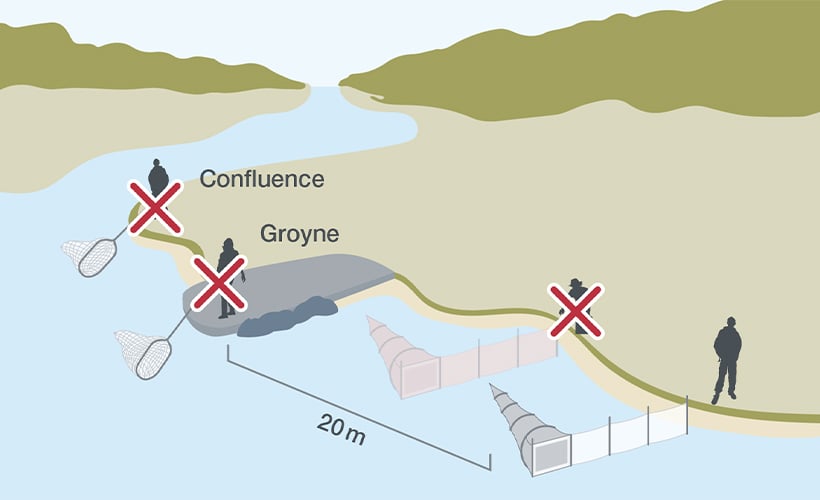
Image: DOC
Licensed structures (stands)
A licensed structure, commonly called a “stand”, is any structure authorised to be used to fish for whitebait under the Resource Management Act 1991. The licensing of stands is managed by regional councils.
If you are whitebaiting from a licensed structure, the usual whitebait rules apply, except that you can use more than 3 m of screens, provided the total length of all your fishing gear does not exceed 6 m.
In the West Coast of the South Island, only one net must be used from a stand. See Additional rules - West Coast of the South Island for more information.
Additional rules - West Coast of the South Island
If you are fishing for whitebait on the West Coast of the South Island, some specific rules apply:
- Screens must always be set from the water’s edge. To keep the screens at the water’s edge, they must be moved with the ebb and flow of the tide.
- Screens must never be on the outside of the net. They can only be on the bank side. Do not place a screen beyond the whitebait net.
- When fishing from a licenced structure (stand), screens must not extend beyond the outer edge of the structure.
- Nets set from licenced structures (stands) must be in a straight line with the edge of the structure.
- Only one net must be used from a licenced structure (stand), whether by the fisher or any other person using that structure. This includes scoop nets as well as set nets.
- You must not use drag nets on the West Coast of the South Island.
Report illegal activity
It's important we all fish responsibly and sustainably. If you see anyone illegally whitebaiting, contact us.
Contacts
Contact your local DOC office for more information or email whitebait@doc.govt.nz.