Pre-application advice
Applying for a permit for the first time can be a little tricky. To ensure your application goes smoothly we advise you to contact us for pre-application advice.
We’ll help you to:
- understand the permission(s) you will need to apply for
- navigate our statutory planning documents, so you can consider whether the activity you wish to carry out is consistent with them
- understand your requirements to tell us about the potential effects your activity may have on iwi rights and interests. If you wish, DOC can help you make contact with iwi who have interests in the area to help you assess those effects
- learn about DOC’s responsibilities to give effect to the principles of the Treaty of Waitangi and meet our Treaty settlement obligations, which requires DOC to engage with our Treaty partners on most applications.
Applications for marine protection permits
The Hauraki Gulf/Tīkapa Moana Marine Protection Act introduced new high protection areas and seafloor protection areas in the Hauraki Gulf/Tīkapa Moana. The Act aims to enhance the health and mauri of the Hauraki Gulf/Tīkapa Moana for future generations by limiting the activities that can occur in protection areas.
View all High protection areas and seafloor protection areas in the Hauraki Gulf to learn more about the locations of the protection areas.
The new protections mean you need a permit to carry out active restoration and other prohibited activities in protection areas.
Restoration activities
DOC has identified active restoration activities that have a clear and restorative benefit to the health of protection areas, and are likely to have minimal negative ecological effects.
These restoration activities are:
- kelp forest restoration – kina/urchin control, reseeding pāua, reseeding of seaweed
- soft sediment restoration – scallop larval capture, mussel reseeding, mussel larval capture
- water sampling activities – removal of small amounts of water (1L per sample unit) up to a maximum of 120L per protection area per year.
If your proposed activity is a restoration activity, let us know in the application form. Applications for restoration activities are generally processed more quickly.
Other prohibited activities
Our statutory requirements mean we can only grant your application if we are satisfied that:
- the activity is consistent with the purpose of the protected area, and
- you will take reasonable steps to avoid, remedy, or mitigate any adverse effects of the activity on the rights and interests of iwi that exercise kaitiakitanga in the protected area.
If we are not satisfied you application meets the above criteria, we may grant your application if we are satisfied that:
- your activity is necessary and can only occur in the protected area, and
- you will take reasonable steps to avoid, remedy, or mitigate any adverse effects of the activity on the rights and interests of iwi that exercise kaitiakitanga in the protected area.
It is unlikely that applications for commercial and recreational fishing will meet these criteria.
You must apply for a permit if you would like to carry out the activities listed below.
High protection areas
- aquaculture activities, such as breeding, hatching, cultivating, rearing, or ongrowing fish, aquatic life, or seaweed for harvest
- removal of large amounts of non-living materials like sand, stone, or driftwood
- dumping or discharging waste, sewerage, or litter
- landing aircraft, including drones
- catching or taking fish, such as collecting living samples of marine life
- activities that disturb sea life and habitats, such as construction, destruction, drilling, vibrations, explosions, mining, and introducing living organisms.
Seafloor protection areas
- aquaculture activities, such as breeding, hatching, cultivating, rearing, or ongrowing fish, aquatic life, or seaweed for harvest
- removal of large amounts of sand
- high impact bottom fishing methods
- dumping or discharging waste, sewerage, or litter
- mining activity.
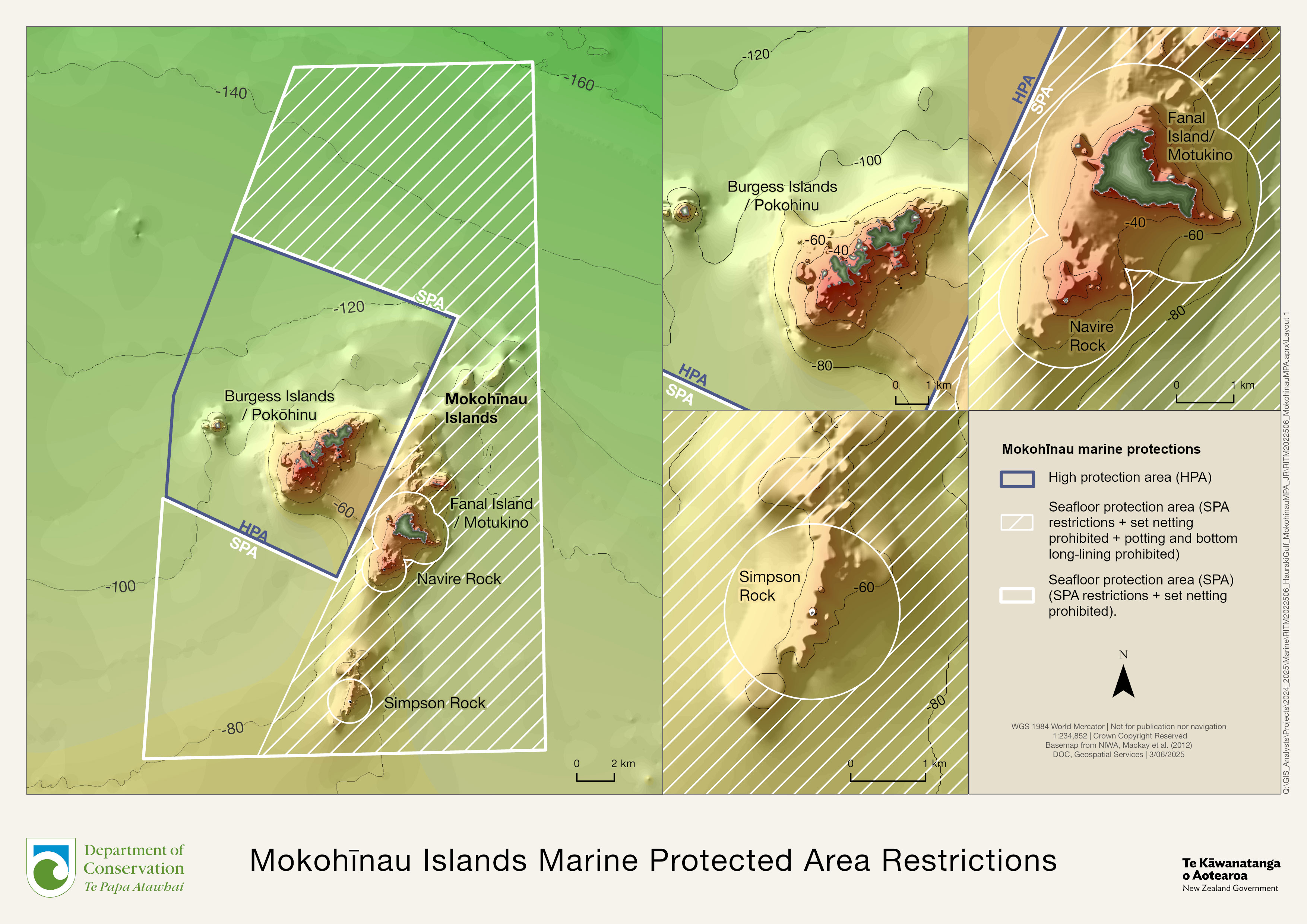
Mokohīnau Islands Seafloor Protection Area
- set netting
- potting or bottom longlining within the white hatched area shown on the map of the Mokohīnau Islands Seafloor Protection Area (JPG, 1,012K) (also known as the area marked A on Survey Office Plan 604785).
Apply for a permit
To apply you will need to:
- check the Hauraki Gulf/Tīkapa Moana marine protection maps to identify the location of your proposed activity
- fill in the Hauraki Gulf/Tīkapa Moana Protected Area Permit application form (PDF, 238K) or (DOCX, 117K)
- email the form along with the relevant documents requested to permissions@doc.govt.nz.
If your application is approved, we will send you a permit. You must confirm to us that you have received your permit.
Application requirements
Marine and Coastal Area (Takutai Moana) Act 2011 and resource consent applications
If your proposed activity requires resource consent and will take place in the common marine and coastal area, you may have obligations under the Marine and Coastal Area (Takutai Moana) Act in the consent application process to:
- seek written approval from the relevant protected customary rights group for your activity
- provide information to the consent authority on how you met your requirements to notify and seek the views of customary marine title applicant groups in the area
- obtain permission from the relevant customary marine title group for your activity.
If these obligations apply to your activity, you need to tell us in the application form whether you have met these requirements.
For more information on your requirements:
- contact the consent authority in the first instance.
- visit Te Tari Whakatau - Resource consents and Te Tari Whakatau - Applications.
- contact aucklandpermissions@doc.govt.nz to set up a pre-application meeting.
Effects of your activity
As part of your application, you need to tell us about the potential effects of your activity on:
- the protection area, and
- the rights and interests of iwi that exercise kaitiakitanga in the protection area.
We recommend you arrange a pre-application meeting so we can help you understand the information that is required for the activity you are applying for. We can also help you make contact with iwi that exercise kaitiakitanga in the protected area to inform your assessment of potential effects on their rights and interests.
More information
Find out more about the process and how to prepare your application:
Timeframes
Restoration applications are generally processed more quickly. Complex applications could take a number of months to be processed.
In some circumstances there may be delays in processing while we establish processes for assessing applications for these new permits. We will work to minimise frustration for applicants.
See How long it takes to process an application for more information on application timeframes.
Fees
Processing fees
We charge an application processing fee based on the time required to process your application and staff hourly charge-out rates. Complex applications cost more as they take longer to process.
After you apply, we will assign your application to a processing category that reflects its complexity. Each category has a minimum processing fee.
Learn more about processing categories and minimum fees
If you seek pre-application advice, we can tell you the category and minimum processing fee that will most likely apply to your application. We will confirm your minimum processing fee once your application is accepted and assigned to a processing category. If we expect your processing fee to exceed the minimum fee, we will give you a non-binding fee estimate before we start work.
We will usually invoice your fee after processing is complete. If you withdraw your application, you will be charged for any work already done.
If your application is approved, ongoing permission fees may apply.
Other fees
If DOC decides your permit requires ongoing monitoring and/or management, we will charge these based on the actual time spent undertaking the monitoring and/or management, and the fee will reflect the associated costs, including staff time.
We will advise you of those costs before they are incurred.
If your activity is commercial you may be required to pay royalty fees. We will outline these to you before issuing you a permit.
Amending a permit
If you are seeking an amendment to the conditions of an existing permit, you need to submit an application.
To apply you will need to:
- fill in the Hauraki Gulf/Tīkapa Moana Protected Area Permit Application form (PDF) or (Word).
- email the form along with the relevant documents requested to permissions@doc.govt.nz.
If your amendment application is approved, we will send you a new permit with the amended conditions. You must confirm to us that you have received a copy of the new permit.
We will give you a reasonable timeframe to comply with the amended conditions.
When a permit is not required
You do not need a permit for most recreational activities or for the activities listed in Section 26 of the Hauraki Gulf/Tīkapa Moana Marine Protection Act.
Check What you can and can't do in Hauraki Gulf/Tīkapa Moana marine protection areas to learn about what activities you can do in protection areas without a permit.
Contact us
For more information or assistance with your application contact aucklandpermissions@doc.govt.nz.