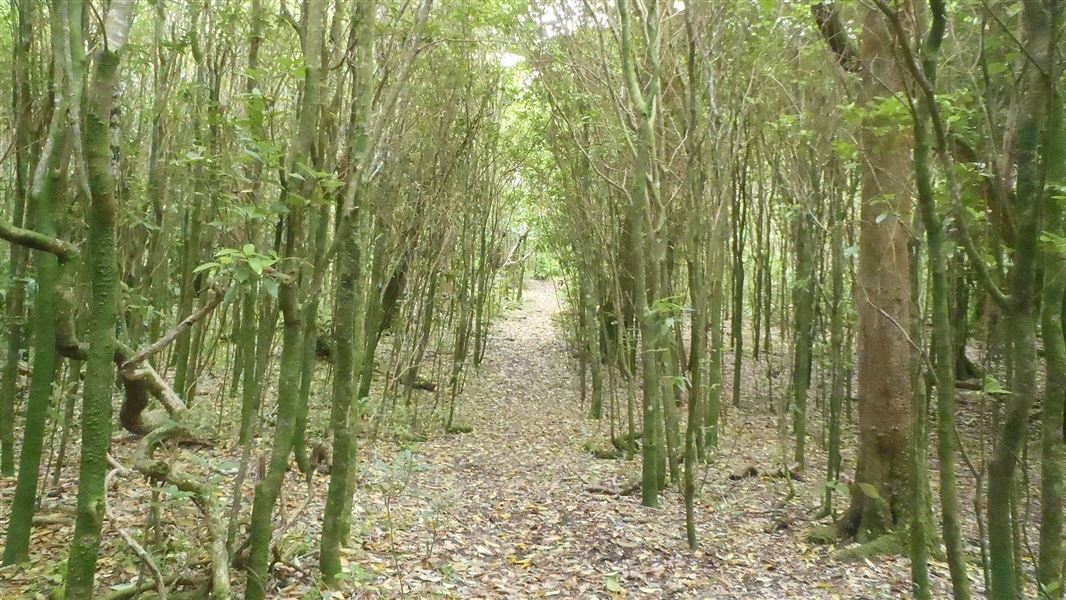
Hundreds of years ago ancestors of the Moriori, the indigenous people of the Chatham Islands, carved images onto the trunks of living trees. A number of these carvings, or dendroglyphs, survive protected in this national historic reserve.
Traditional motifs carved onto living trees are globally very rare. Other examples exist in Australia, United States of America and Sweden.
The style and number of the dendroglyphs on the Chatham Islands are unique and are regarded as being internationally significant. Typically, most Moriori dendroglyphs depict a human form but there are also other patterns depicting fish and birds.
The exact meaning of the carvings remains unknown, but they are still very much regarded as a sacred treasure by Moriori.
Surveys of the carvings have been undertaken since early last century. The first conservation step was in 1979 when landowner J.M. Barker gifted the land to the nation.
DOC manages the reserve in partnership with the Hokotehi Moriori Trust. Many of the carvings are disappearing as disease and wind erosion take their toll on the trees.
In 2010 DOC led a groundbreaking project with the University of Otago and Chatham Island Moriori to scan the carved surfaces of the trees with a three-dimensional laser scanner to record the images for posterity. It is the first time this technology has been used to record heritage features in New Zealand.
Read about 3D laser scanning of the Chatham Island dendroglyphs.