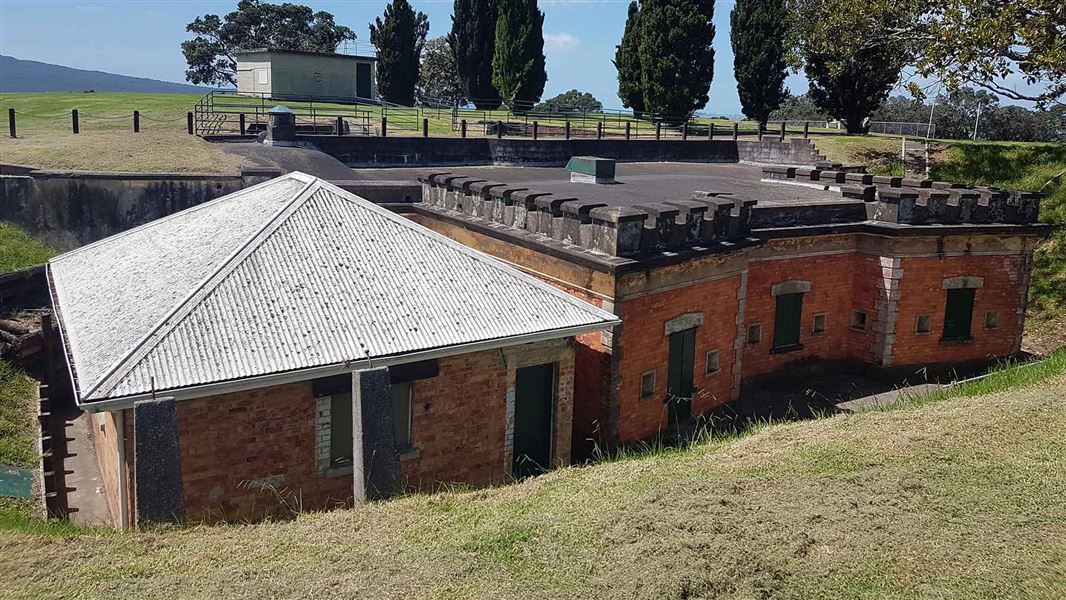
Fort Takapuna sits on a commanding position at the head of the Rangitoto Channel in the Hauraki Gulf.
The site has served its community diversely as a defence and lookout post, medical centre, and training camp that reinforced New Zealand’s involvement on a global scale during times of conflict.
Notable defensive features of the fort include twin six-inch disappearing guns, an underground magazine, and barracks.
Image gallery
Fort Takapuna Historic Reserve is on Vauxhall Road, next to Narrow Neck Beach on Auckland's North Shore.
Ferries run regularly between downtown Auckland and Devonport. You can also access Devonport by road.
Fort Takapuna is a 40 minute walk from Devonport. From Devonport follow King Edward Parade along the waterfront, turn left into Church Street and right into Vauxhall Road. Alternatively, catch the bus to Takapuna via Narrow Neck.
- No dogs are allowed on the reserve between 9am and 7pm from the Saturday of Labour Weekend to Easter Monday. Find out more about dog access on conservation land.
- There are steep drop-offs along the coastal cliff top and around some of the historic structures.
- Take care when exploring the reserve and supervise children at all times.
- There are no toilets on the reserve. Facilities are available at Narrow Neck beach.
- No fires.
- No camping.
- Do not remove or disturb any artefacts or other historic remains.
Non-compliance with these conditions may result in prosecution.
Fort Takapuna Historic Reserve contains elements from all periods of coastal defence in New Zealand. Notable defensive features of the fort include twin six-inch disappearing guns, an underground magazine, and barracks.
The fort houses two massive searchlights, which swept the Hauraki Gulf every night from 1899 until the end of World War II. The Examination Battery, first established in 1938, was used to control the harbour’s anchorage.
Fort Takapuna is set below ground level and surrounded by a dry moat that protected the central fort from land attacks.
The protected headland
Tainui ancestor Peretū settled and named the site, which was inhabited by various local tribes until Crown purchase in 1841.
Fort Takapuna was built in the 1880s to combat threats of Russian invasion, but Japanese entry into World War II incentivised additional firepower and new barracks.
A global centre
Fort Takapuna served as a training area for soldiers from across New Zealand, Niue and Rarotonga.
In 1919 Fort Takapuna’s Camp Hospital quarantined flu victims, and after WWII it served as a maternity ward.
Fort Takapuna was the only coast defense in continuous operation in Auckland during WWII, a vital part of New Zealand’s protection. The Women’s Army Auxiliary Corps worked the fort’s guns, searchlights, and hospital from 1942.
Enduring pursuits
The Royal New Zealand Navy has occupied the site since 1963, with the Officer and Trade Training Schools still in action.
Over its modern 140 year history, Fort Takapuna has stood at the centre of development for New Zealand’s’ defensive technology.
Further reading
Auckland information
| Phone: | +64 7 867 9080 |
| Email: | kauaerangavc@doc.govt.nz |
| About: | Kauaeranga Visitor Centre provides visitor information for this area |