New Zealand status: Endemic
Conservation status: At Risk – Declining
International conservation status: Critically Endangered (IUCN)
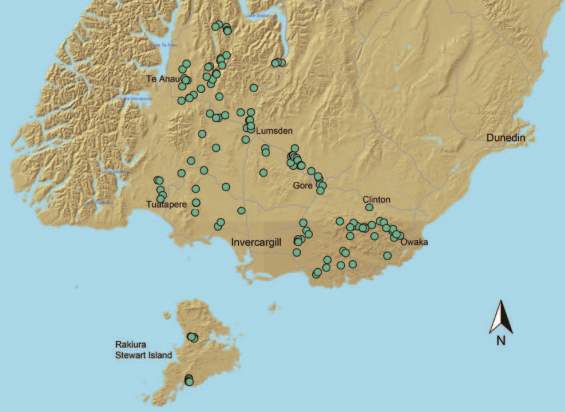
Found in: Small streams, ditches and remnant wetland habitats in the Mataura, Oreti, Waiau and Aparima Rivers, as well as waterways in The Catlins and Stewart Island/Rakiura.
Threats: Habitat loss from land development, predation by introduced fish, drain clearance and wetland loss, reduction of native vegetation and forest harvesting.
Image gallery
Habitat
Gollum galaxias (Galaxias gollumoides) can be found in a wide range of habitats from lowland wetlands near sea level to small headwater streams in high country tussocklands up to 1100 m above sea level.
They can be seen in slow-moving water on the edges of small waterways, and in wetlands, ponds or ditches among aquatic plants and woody debris.
Gollum galaxias are distributed throughout Southland with population strongholds present in the Mataura, Oreti, Waiau, Aparima, Catlins and Ōwaka rivers.
Incredibly, some populations can even be found on Stewart Island/Rakiura, thought to have been distributed there during the Pleistocene ice age when a land-bridge was present.
Features
Features of Gollum galaxias include:
- grey to olive green in colour and covered in dark-brown splotches or speckling; they look like they’ve been dipped in gold metallic dust
- characterised by their short, stocky bodies, large eyes and blunt, rounded snouts
- typically grow up to 70 mm in length but can get to 140 mm
- feed on small stream invertebrates such as mayflies and stoneflies
- spawn in spring (late August to October) laying tiny 2 mm eggs in small ‘caves’ under boulders in streams and on plants in wetlands.
Threats
Their main threats are habitat loss from land development and water abstraction, and predation by introduced fish species such as trout.
Other threats include stock access to streams, reduction of native vegetation, and forest harvesting.
These changes in land use impact on the streams in which galaxiids live, increasing sedimentation, changing natural flows through water abstraction, and reducing habitat available for spawning.
Find out how you can help non-migratory galaxiids.
Distribution
This map shows the known locations of Gollum galaxias, as at 2013.
Source: New Zealand freshwater fish database