
DOC invests heavily in the safety of its visitors through communications and visitor infrastructure. Safety-related communications include general and site-specific information and guidance in DOC publications and on the DOC website. This safety information is supported by up-to-date information on track conditions and hazards communicated through DOC’s website and Visitor Centres. Safety-related infrastructure includes tracks, shelters, barriers, bridges and signage. The integrity and functionality of this infrastructure is maintained through a rigorous inspection and maintenance regime (refer to factsheet: Key types of visitor assets managed by DOC are meeting the required performance standard).
A measure of the performance of these efforts is the extent to which visitors’ perceptions and experiences regarding their own safety and wellbeing met their expectations, and were consistent with DOC’s messaging.
| Agree I felt safe at all times | Count | Percent |
|---|---|---|
| Totally | 2047 | 36 |
| A lot | 2540 | 45 |
| Moderately | 795 | 14 |
| Slightly | 188 | 3 |
| Not at all | 81 | 1 |
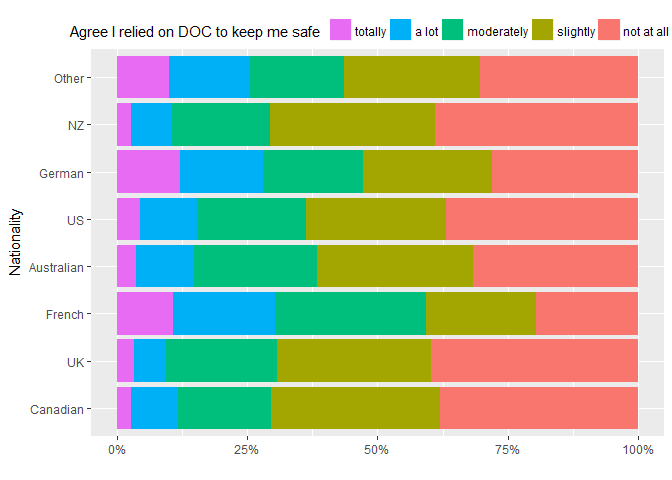
Substantial proportions of respondents from some nationalities agreed totally that they relied on DOC to keep them safe on their ‘Great Walk’. This finding is in marked contradiction to DOC’s stated policy on visitor risk management and DOC communications, both of which emphasise that visitors alone are responsible for their own safety and wellbeing, and that of others in their care.
Total reliance was low for major English-speaking groups (New Zealand, Australia, United Kingdom, United States and Canada), but for German, French and the remaining group of respondents, more than 10% agreed totally that they relied on DOC (Figure 1). As this level of reliance represents a substantial number of ‘Great Walk’ customers, further research to understand this ‘contrary’ perspective is required to allow evaluation of any action needed.
The ‘Great Walk Guest Survey’ for 2016/17 comprised an integrated pair of web-based questionnaires that ran for the duration of the ‘Great Walk’ walking season (Oct 2016-May 2017). The questionnaires included both quantitative and qualitative questions.
This report relates to the following ‘Outcomes Monitoring Framework’ (OMF) Indicator and Measures for ‘Intermediate Outcome 3: New Zealanders and our visitors are enriched by outdoor experiences’:
Indicator 3.2.2: Opportunities, facilities and services provided meet customer expectations and preferences
The Department of Conservation’s (DOC) Outcomes Monitoring Framework (OMF) provides a platform on which DOC and others can assess outcomes in a clear, structured and transparent way (Lee et al., 2005). It has been developed as a logical hierarchy that is based on broad, overarching Outcomes, beneath which are nested Outcome Objectives, Indicators, Measures and Data Elements to provide ever-increasing levels of detail. The framework is scalable, as the indicators and measures remain compatible and consistent whether applied locally, regionally or nationally.
Recently updated and expanded, the OMF provides a roadmap for gathering information to meet the specific objectives of DOC and other agencies (McGlone and Dalley, 2015).
The provision of a national framework with agreed outcomes, indicators and measures supports collaboration with national and regional land management and regulatory agencies, as well as other stakeholder groups. This enables more integrated policy development and status reporting.
DOC has partially implemented a national monitoring and reporting system, whereby priority ‘Indicators’ and ‘Measures’ selected from the OMF are routinely used to report on progress against DOC’s stated objectives and outcomes. This factsheet reports on a measure for the 2016/2017 year.
McGlone, M., Dalley, J., 2015. A framework for Department of Conservation inventory and monitoring: Intermediate outcomes 1-5. Landcare Research Contract Report LC2427 (unpublished) for the Department of Conservation, Wellington.