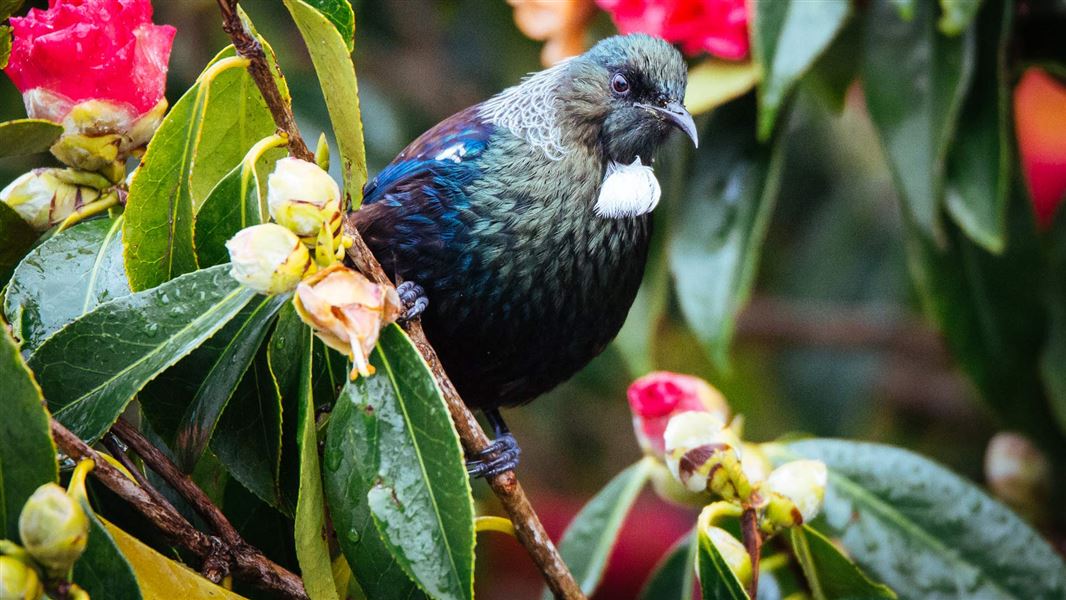
To support our native birds, you can hang water baths, plant native flowering trees, and leave areas of leaf-litter around your garden.
On this page:
- Common species and their diet
- What to plant
- Monthly calendar of plants for birds
- Keep the birds safe
- Habitat requirements
Common species and their diet
Whether you have a large site to restore, or planning a new garden at home, invite the birds over with plants that provide a year round supply of food.
A small garden can still attract birds, especially over winter and spring when tūī, bellbird/korimako and wood pigeons/kererū will travel considerable distances in search of flowers and fruit.
Try to use ecosourced plants (plants that naturally occur in your area). These could include kōwhai, flax, kākābeak, and tarata for nectar; and wineberry/makomako, karamū, and korokia for fruit.
| Species | Fruit | Foliage | Nectar | Insects | Other |
|---|---|---|---|---|---|
| Bellbird/Korimako | Y | Y | Y | ||
| Fantail/Pīwakawaka | Y | ||||
| Grey warbler/Riroriro | Y | ||||
| Kākā | Y | Y | Y | Seeds and tree sap | |
| Wood Pigeon/Kererū | Y | Y | Flowers | ||
| Kingfisher/Kōtare | Y | Lizards, small rodents | |||
| Shining cuckoo/Pīpīwharauroa | Y | ||||
| Morepork/Ruru | Y | Small rodents, birds, lizards | |||
| Tūī | Y | Y | Y | ||
| Wax/White/Silvereye/tauhou | Y | Y | Y |
If you have limited space for big trees, try growing plants in containers, e.g. tītoki, broadleaf and cabbage tree. Some shrubs like kākābeak can even be shaped to fit in with your garden design - but make sure you allow them to flower so the birds benefit.
What to plant
There are many native trees, shrubs and climbers that look attractive in the garden and also provide shelter and food for wildlife. The following is a selection only, and not all will grow in every part of the country.
There are numerous hybrids and cultivars of native plants developed for garden situations. These should not be planted in or near natural bush to avoid cross-pollination.
The advantage of ecosourced plants is that native wildlife has coexisted with them for thousands of years, and has adapted to using them as a food source. Your local plant nursery should be able to advise further.
| Botanical name | Common name | Features |
|---|---|---|
| Trees over 6 metres | ||
| Alectryon excelsus | tītoki | red fruit |
| Carpodetus serratus | putaputawētā | lilac flower |
| Cordyline australis | cabbage tree/tī kōuka | cream flower |
| Coprosma repens | taupata | orange/yellow fruit |
| Griselinia littoralis | broadleaf/kāpuka | purple fruit |
| Fuchsia excorticata | kōtukutuku or kōnini | red flower, black fruit |
| Knightia excelsa | rewarewa | red flower |
| Melicytus ramiflorus | māhoe | violet fruit |
| Pennantia corymbosa | kaikōmako | black fruit |
| Pittosporum eugenioides | lemonwood/tarata | yellow flower |
| Pittosporum tenuifolium | kōhūhū | dark red flowers |
| Pseudopanax arboreus | five- finger/whauwhaupaku | black fruit |
| Schefflera digitata | patē | purple/black fruit |
| Sophora tetraptera | kōwhai | yellow flower |
| Vitex lucens | pūriri | red flower |
| Trees and shrubs (approx 1.5m to 6m) |
||
| Aristotelia serrata | wineberry/makomako | deep red fruit |
| Brachyglottis repanda | rangiora | yellow flower |
| Coprosma rhamnoides | coprosma/karamū | crimson fruit |
| Coprosma robusta | karamū | orange/red fruit |
| Coprosma grandifolia | kanono | orange fruit |
| Cordyline indivisa | mountain cabbage tree/tī kōuka | cream flower |
| Corokia species | korokio | orange to red fruit |
| Leptospermum scoparium | mānuka | white/pink flower |
| Marcopiper excelsum | kawakawa | orange fruit |
| Myrsine australis | māpou | black fruit |
| Phormium tenax | NZ flax/harakeke | yellow flower |
| Pittosporum crassifolium | karo | crimson flower |
| Pomaderris apetala | tainui | yellow flower |
| Pomaderris kumeraho | kūmaraho | yellow flower |
| Pseudopanax laetus | five-finger/whauwhaupaku | black fruit |
| Sophora microphylla | kōwhai | yellow flower |
| Shrubs (approx 500 mm to 1.5 m) |
||
| Alseuosmia macrophylla | toropapa | cream to red flower, red fruit |
| Astelia nervosa | astelia/kakaha | orange fruit |
| Clianthus puniceus | kākābeak | red flower |
| Coprosma cheesmanii | coprosma/karamū | orange red fruit |
| Corokia cotoneaster | korokio | red fruit |
| Hebe species | hebe/koromiko | flowers various colours |
| Libertia grandiflora | NZ iris/tūkāuki | orange seed pod |
| Melicytus micranthus | manakura | purple to white fruit |
| Phormium cookianum | dwarf mountain flax/harakeke | yellow flower |
| Rhabdothamnus solandrii | mātātā | yellow to red flower |
| Low-growing plants (to 500 mm approx) |
||
| Coprosma acerosa & brunnea | sand coprosma/tātaraheke | pale blue fruit |
| Dianella nigra | NZ blueberry/tūrutu | blue fruit |
| Fuchsia procumbens | fuchsia/kōnini | red fruit |
| Hebe species | hebe/koromiko | flowers various colours |
| Libertia ixioides or L.peregrinans | NZ iris/tūkāuki | orange seed pod |
| Muehlenbeckia axillaris | creeping pōhuehue | white fruit |
| Parahebe species | parahebe | white flower |
| Podocarpus nivalis | mountain tōtara | red fruit |
| Pratia angulata | creeping pratia | purple/red fruit |
| Container plants | ||
| Alectryon execelsus | tītoki | red fruit |
| Astelia species | kakaha | orange fruit |
| Clianthus species | kākā beak | red flower |
| Cordyline australis | cabbage tree/korokio | cream flower |
| Cordyline indivisa | mountain cabbage tree/korokio | cream flower |
| Griselinia littoralis | broadleaf/pāpāuma | purple fruit |
| Phormium species | NZ Flax/harakeke | yellow flower |
| Pittosporum species | karo | yellow to red flowers |
| Pseudopanax species | five-finger/whauwhaupaku | black fruit |
| Vitex lucens | pūriri | pink/red flower, red fruit |
| Climbers | ||
| Metrosideros carminea | carmine rata | crimson flower |
| Passiflora tetranda | kōhia | orange fruit |
| Tecomanthe speciosa | large tree vine | cream flower |
Monthly calendar of plants for birds
This monthly calendar shows when plants will provide nectar, fruit or seeds for native birds.
Key:
N - Nectar
FS - Fruit and seeds
FSN - Fruit, seeds and nectar
| Common name | Botanical name | J | F | M | A | M | J | J | A | S | O | N | D |
|---|---|---|---|---|---|---|---|---|---|---|---|---|---|
| Akatea | Metrosideros fulgens | N | N | N | N | N | |||||||
| Astelia/kakaha | Astelia nervosa | N | FSN | FS | FS | FS | |||||||
| Cabbage tree/korokio | Cordyline australis | FS | FS | FS | FS | N | |||||||
| Fivefinger/whauwhaupaku* | Pseudopanax arboreus | FS | FS | FS | FS | ||||||||
| Fivefinger/whauwhaupaku* | Pseudopanax laetus | FS | FS | FS | FS | ||||||||
| Flax (mountain)/harakeke | Phormium cookianum | N | N | N | N | ||||||||
| Flax (lowland)/harakeke | Phormium tenax | N | N | N | |||||||||
| Hīnau | Elaeocarpus dentatus | FS | FS | FS | FS | FS | FS | ||||||
| Kahikatea | Dacrycarpus dacrydiodes | FS | FS | FS | |||||||||
| Kaikōmako* | Pennantia corymbosa | FS | FS | FS | FS | N | N | ||||||
| Kākābeak | Clianthus puniceus | N | N | ||||||||||
| Kanono* | Coprosma grandifolia | FS | FS | FS | FS | ||||||||
| Karaka*+ | Corynocarpus laevigatus | FS | FS | FS | |||||||||
| Karamū* | Coprosma lucida | FS | FS | FS | FS | ||||||||
| Karamū* | Coprosma rhamnoides | FS | FS | FS | |||||||||
| Karamū* | Coprosma robusta | FS | FS | FS | FS | ||||||||
| Karo | Pittosporum crassifolium | FS | FS | FS | FS | N | N | N | N | N | |||
| Kawakawa+ | Macropiper excelsum | FS | FS | ||||||||||
| Kohekohe+ | Dysoxylum spectabile | N | N | N | N | ||||||||
| Kōhūhū | Pittosporum tenuifolium | N | FS | FS | FS | FS | N | N | N | ||||
| Kōtukutuku* | Fuchsia excorticata | FS | FS | FS | N | N | N | N | FSN | ||||
| Korokio | Corokia cotoneaster | FS | FS | FS | N | N | N | ||||||
| Kōwhai | Sophora microphylla | N | N | N | |||||||||
| Māhoe*+ | Melicytus ramiflorus | FS | FS | FS | |||||||||
| Māpou | Myrsine australis | FS | FS | FS | FS | FS | FS | FS | FS | ||||
| Miro | Prumnopitys ferruginea | FS | FS | FS | FS | ||||||||
| Native broom/maukoro | Carmichalia williamsii | N | N | N | |||||||||
| Northern rata | Metrosideros robusta | N | N | N | N | N | |||||||
| NZ blueberry/tūrutu | Dianella intermedia | FS | FS | FS | FS | ||||||||
| Patē+ | Schefflera digitata | FS | FS | ||||||||||
| Pigeonwood/porokaiwhiri*+ | Hedycarya arborea | FS | FS | FS | FS | FS | FS | ||||||
| Pōhutukawa+ | Metrosideros excelsa | N | FS | FS | FS | N | N | ||||||
| Pūriri+ |
Vitex |
FSN | FSN | FSN | FSN | FSN | FSN | FSN | FSN | FSN | FSN | FSN | FSN |
| Putaputawētā | Carpodetus serratus | FS | FS | FS | |||||||||
| Rewarewa | Knightia excelsa | N | N | N | N | ||||||||
| Rimu* | Dacrydium cupressinum | FS | FS | FS | |||||||||
| Taraire | Beilschmiedia taraire | FS | FS | ||||||||||
| Tarata* | Pittosporum eugenoides | FS | FS | FS | N | N | N | ||||||
| Taupata+ | Coprosma repens | FS | FS | FS | |||||||||
| Tawa | Beilschmiedia tawa | FS | FS | ||||||||||
| Tītoki+ | Alectryon excelsus | FS | FS | FS | FS | FS | |||||||
| Toropapa | Alseuosmia macrophylla | FS | FS | FS | FS | N | N | N | FS | FS | |||
| Tōtara | Podocarpus totara | FS | FS | ||||||||||
| Wharangi+ | Melicope ternata | FS | FS | ||||||||||
| Wineberry/makomako* | Aristotelia serrata | FS | FS | FS |
* Species for which several individuals may have to be planted to ensure fruiting
+ Frost tender (especially when young)
Download the calendars:
Keep the birds safe
Plant favourite bird foods like flax/harakeke and kōwhai where you can see them from inside the house. But avoid planting too close to the house as reflections on windows can confuse birds. A number of kererū are killed every year trying to fly through panes of glass.
Birds such as fantail/pīwakawaka, grey warbler/riroriro and silvereye/tauhou are insect eaters so plant varieties are not as important as a healthy mix of spiders, moths, beetles, and earthworms etc. A good layer of mulch or leaf litter on the garden will encourage insects, and birds are a natural way of keeping them under control. Morepork/ruru and kingfisher/kōtare eat insects as well as mice.
Some native birds have become wary about feeding on the ground. Think about growing ground creepers like Fuchsia procumbens in a hanging basket - a wonderful sight with red berries hanging down. Climbing plants like Metrosideros carminea (crimson rata) and Passiflora tetrandra (NZ passionfruit/kōhia) could grow along a wall or over a pergola.
Stoats, rats, weasels, possums, cats and hedgehogs prey on birds, including their eggs and nestlings. If you want to keep the birds flourishing, controlling pests is a must. Setting traps, and laying poisons (toxins) in bait stations are suitable methods of control.
Habitat requirements
Before planting, check if there is already a reliable food source at the site in terms of fruiting, flowering and seeding trees. The thickness of leaf litter is also a factor for insect-feeding birds and lizards.
Wildlife has different requirements for nesting sites and hiding places. Kingfisher/kōtare morepork/ruru and longtailed bat/pekapeka, for example, prefer standing dead trees whilst lizards will use fallen logs.
Your site may not be large enough for some species to nest and breed but they may still use it as a seasonal feeding ground. Many areas of native bush and wetlands are now small and widely spaced across the landscape. Your garden may help birds move between these areas.